




4.8/5 star
Rated Article
4 Reasons EAPs Won’t Work in 2026
We asked employers with 12,000+ employees and found these 4 common reasons which ‘failed’ their EAP.
+ how to AUDIT & how to FIX them!
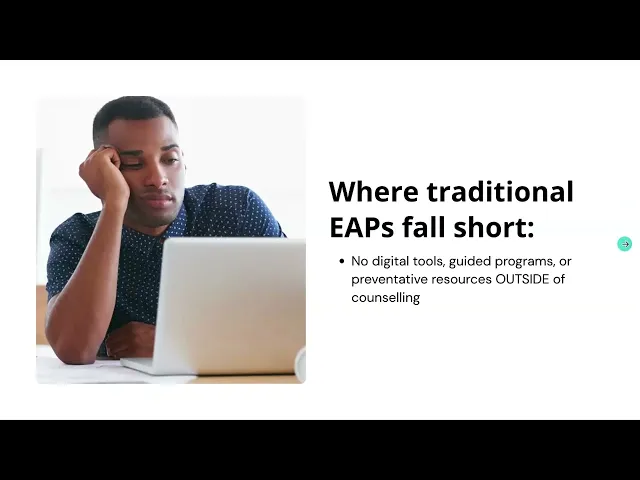
Watch 7-min Guide ↓


Here’s The Background (Important)
Most EAPs are failing — not because HR doesn’t care, but because the traditional EAP model was built decades ago.
Employees today expect accessibility, psychological safety, and a modern wellbeing experience. This premium guide breaks down the REAL reasons your EAP is underperforming and gives you practical fixes you can implement immediately.
NNn
Reason 1: Low Awareness and Visibility
Why it fails
Most staff only hear about their EAP when:
They're onboarded
An incident happens
Their manager says, “You can call the EAP if you need help”
After that, it disappears into the background.
Employees can’t use what they don’t know exists.
And in most organisations, fewer than 5% of employees ever reach out.
What to do instead
1. Treat awareness like a campaign, not a one-off.
Send reminders at least quarterly — not just in onboarding.
2. Integrate it into everyday communication.
Slack/Teams reminders, posters, manager talking points, intranet pop-ups.
3. Make it normal, not reactive.
Shift the message so staff see the EAP as support for everyday stress, not just crisis moments.
Reason 2: Lack of Trust and Psychological Safety
Why it fails
Even when people know the EAP exists, they’re unsure about:
Who sees their information
Whether HR gets notified
Whether their manager will find out
Whether it’s actually confidential
This uncertainty stops people from reaching out.
What to do instead
1. Make confidentiality your most repeated message.
Explain clearly:
What’s shared
What isn’t
How anonymity is protected
How staff data is handled
2. Share real examples (without identifying details).
Show how people use it in ordinary situations.
3. Train managers to reinforce safety.
Managers must speak about confidentiality accurately and consistently.
Reason 3: Long Wait Times and Access Barriers
Why it fails
Traditional EAPs rely on hotline triage and outdated systems.
That leads to:
Long waitlists
Slow call-backs
No visibility on appointment availability
Staff giving up before they ever get help
When someone finally decides to seek support, slow access kills momentum.
What to do instead
1. Prioritise instant booking options.
People should be able to book directly, at the moment they need support.
2. Ensure availability across peak times.
Evenings and weekends matter — especially in shift-based industries.
3. Remove unnecessary steps.
No referrals.
No call-backs.
No inbox delays.
If someone needs support, they should be able to book it immediately.
Reason 4: Limited Data and No Real Insights
Why it fails
Leadership teams want to understand:
Usage
Types of support accessed
Common challenges
Staff wellbeing trends
Return on investment
But most EAPs only provide:
A yearly summary
Minimal data
Generic categories
No actionable insights
This makes it impossible to track wellbeing or make informed decisions.
What to do instead
1. Ask for quarterly (or monthly) reporting.
Not just 1–2 generic categories — but meaningful patterns.
2. Track the metrics that matter.
For example:
Usage rate
Engagement by gender/role
Session topics
Repeat sessions
Response times
3. Use insights to shape proactive wellbeing strategies.
The EAP should help you prevent issues — not only respond to them.
Bonus: What a Modern, High-Engagement EAP Looks Like
A modern wellbeing program should feel:
Immediate
Accessible
Confidential
Proactive
Data-driven
And it should provide staff with support for everyday challenges, not just crises.
High-performing programs generally include:
Direct appointment booking
App or digital access
Clear confidentiality messaging
Regular awareness reminders
Consistent manager communication
Frequent reporting
A proactive wellbeing component (mindfulness, coaching, workshops)
Easy ways for staff to reach support immediately
Quick Self-Audit: How Well Is Your EAP Performing?
Score your organisation from 1–5 on each question:
Do our employees hear about the EAP more than once per year?
Do staff fully understand confidentiality and how their data is protected?
Can employees book support directly without going through a hotline?
Can someone get an appointment within 48 hours?
Do we receive meaningful reporting (not just generic categories)?
Are insights used to improve our wellbeing strategy?
Do our managers know how to talk about the EAP correctly?
Does the EAP support everyday challenges (not just crises)?
Is the EAP easy to find, access, and use?
Do we feel confident the program is actually delivering value?
0–20: Needs urgent review
21–35: Some strengths, but major gaps
36–45: Good, but room to improve
46–50: Strong, high-engagement program
Ready to See How Your Program Really Stacks Up?
You can take the short EAP Audit Quiz to get an instant score and a customised breakdown of how your program compares to modern standards.
It takes less than 2 minutes.
Score your EAP honestly. Each ‘No’ indicates a major risk area.
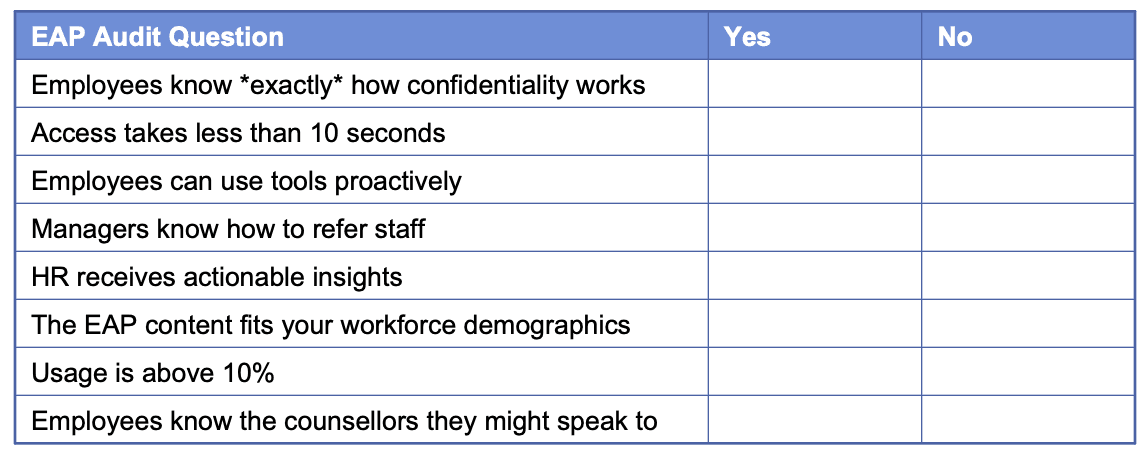
It might be worth a chat.
If you found yourself ticking “No”, you’re not alone — most Australian companies discover their EAP is underperforming without realising it.
That’s exactly why we offer a free 30-minute EAP Performance Review Call.
In this quick session, we’ll:
Pinpoint what’s blocking your EAP from working
Show you simple fixes you can apply immediately
Give you a clearer picture of what “good” looks like in 2026
You’ll Walk Away With
A simple action plan
Immediate improvements you can make
Clarity on whether your current EAP is helping or holding you back
"Mindway is by far the most proactive EAP I have seen"

Margaret P.
Head of HR